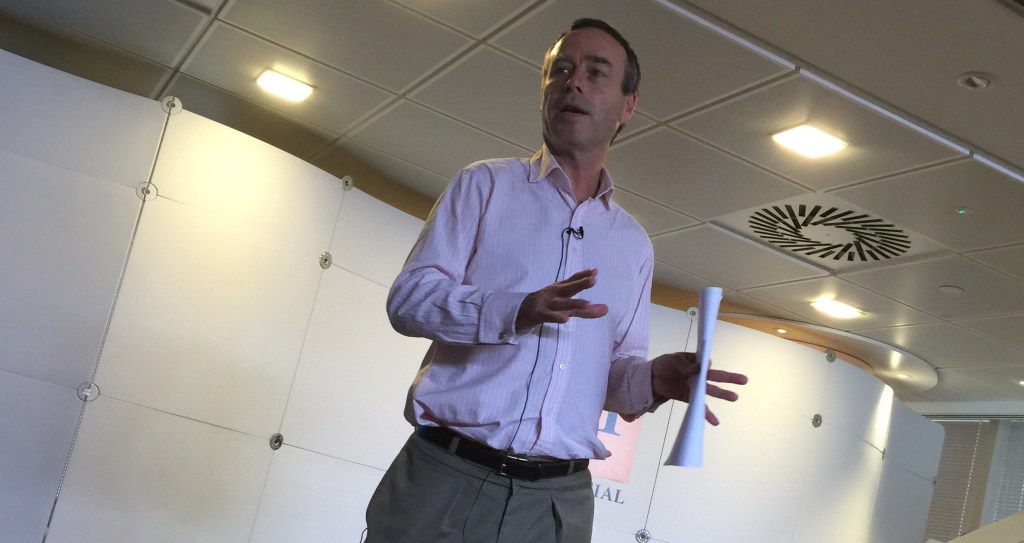
The Financial Times is a media organisation. As you enter you are greeted by a painting of a shark being eaten by ever larger sharks opposite a drawing of Richard Branson made up like Che Guevara. Amongst its general staff there are closer links with organisations like the BBC and the Guardian than the Times or HSBC. When Thatcher died there was much rejoicing. No one wanted the new owner to be Rupert Murdoch. It’s prior owner, corporatist education provider Pearson, is steeped in the profession of teaching. So between its media and educational cultural influences the FT is a perhaps surprisingly a left-wing Obama-backing paper.
Why surprising? Because this culture does not fit with the word Financial in its name and with the usual political views of people in the financial industry. What is finance if it is not the operation of markets? How then is it natural for people with political views that set them against the operation of markets to own or run a Financial anything, let alone a newspaper that lives to help its readers.
Allister Heath wonders if this might change:
Last but not least, it is worth highlighting the company’s mission statement: “Nikkei believes that a free market economy with a small government is the best policy to maximize Japanese welfare.”
And so does the confused Guardianista Justin McCurry (who tellingly assumes the FT is full of right-wingers):
Its reported rival bidder, Axel Springer, publisher of the German tabloid Bild, may have lent the FT’S salmon-coloured pages a more risqué hue. The Nikkei’s raison d’etre is a decidedly less raunchy commitment to the values of the free market, although that hasn’t prevented the ruffling of feathers at the FT’s global network of bureaus.
As a right-winger left feeling distinctly out-of-place in the FT’s programming team, I think the more likely transformation (which Heath misses) is a transformation of Nikkei by the superb FT Technology department.
We [Nikkei] are really impressed by the FT’s innovation in digital media and technology. They employ many engineers and we want to learn from them. They are also developing mobile services which we need to catch up on. We want to study what they are doing in a humble manner.
As to why a left-wing paper would have a superb technology department, don’t get me started…


 Libertarian Home
Leave a reply to Simon Gibbs Cancel reply