
The following text – an edited extract from a book by Dan Hannan – was set out neatly in chalk – in three meticulous columns of block capitals – in Trafalgar Square between 10am and 5pm on Sunday 29th May, by a man wearing old, yet decent, clothes and carrying a bed roll. He was brusk Scot, copying it out from a note book and seeking financial reward in the manner of a pavement artist. We put the first coin – £1 – in his pot. We wish we had given more, and would like to do so should he get in touch.
EU Referendum – a case for Brexit – vote for democracy – vote leave on June 23rd.
 Hi folks! I’m Kenny from Scotland. I am homeless and I’ve been using my free time to do a lot of research concerning next months EU referendum. I hope the info I provide helps you make the right decision next month, or if you are another EU-country, inspires you to vote leave in your country, because our democracy and our rights are under attack by EU-bureaucrats, mega-corporations and their lobbyists. The 28 un-elected EU commissioners to not respect the law.
Why the EU can’t be democratic
On the 18th of April 1951, in the French Foreign Ministry’s imposing Solon de L’Horloge, six men gathered to sign an accord unlike any other. The ‘Treaty of Paris’, which created the European Coal and Steel Community – the first direct ancestor of today’s European Union – which not just bind its members as states. Rather it would create a new legal order, superior to national jurisdictions. The six men were the Foreign Ministers of the founding EEC members: Belgium, Luxembourg, The Netherlands, France, Italy and West Germany. This was the first treaty to which West Germany, recently under allied occupation, had acceded in her own name, and her Chancellor, Konrad Adenauer, was there in person, action as his own Foreign Minister.
When the time came for the the formal signing, though a problem arose. Last-minute negotiations and amendments meant that no official test had been prepared. The six members therefore signed an empty piece of paper, and left their officials to fill in the articles. As one historian of the EU puts it ‘the spirit of the accord stood surety for the letter’.
To British eyes, it is an almost perfect symbol for what has been wrong with the European Union from the beginning. The politicians have left the bureaucrats with, figuratively if not always literally, a series of blank sheets. The bureaucrats, unsurprisingly, have filled in the blanks to suit themselves. Again and again, the Brussels institutions have set aside both public opinion and the clear instructions of members states in order to advance their agenda of ‘more Europe’.
We tend to take ‘the Rule of Law’ for granted. Those four words slide so easily from our tongues that we rarely stop to consider the vastness of what they represent.
When the people in power can no longer make up the rules as they go along, much follows: free contract, free conscience, free speech and, ultimately prosperity, democracy and meritocracy.
In their great study ‘Why nations fail’, James A. Robinson and Daron Acemoğlu showed that in almost every age, people in power arrange things so that they and their heirs can systematically can enjoy the fruits of everyone else’s work. They call this the ‘Extractive State’. The alternative – the Rule of Law, secure property rights and mechanisms to hold those in power to account – came about only in modern times and largely in English speaking countries, though it later spread. They called this the ‘Inclusive State’. As individual countries, the 28 members of the EU qualify as Inclusive States. They are parliamentary democracies and independent judiciaries. They do not systematically expropriate their citizens, intern without trial or forbid emigration. They recognise civil rights and equality before law.
The European Unions founding fathers Jean Monnet and fellow Frenchman Robert Schumann (twice Prime Minister of France) understood very well that a scheme as audacious as theirs, the merging of ancient kingdoms and republics into a single state would never succeed if each successive transfer of power from the national capital to Brussels had to be approved by democratic vote. The EU is run, extraordinarily, by a body that combines legislative and executive power. The European Commission is not only the EU’s ‘Government’; It is also in most fields of policy, the only body that can propose legislation. The 28 commissioners are un-elected.
Elections alone do not make a democracy. There were elections in the Warsaw Pact states throughout the Cold War. There are elections in Iran today. For an election to matter, there has to be a meaningful engagement between voters and government.
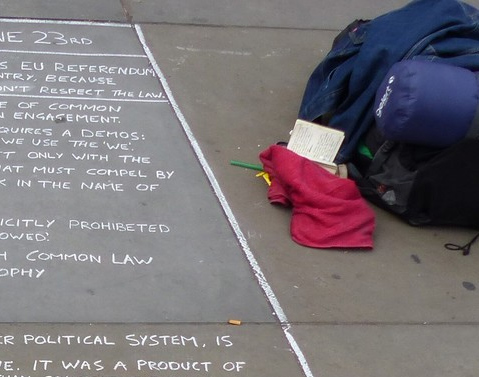 The EU, is lacking in a shared sense of common identity, cannot fabricate such an engagement, to put it in another way. Democracy requires a demos: a unit with which we identify when we use the ‘we’. Take away the demos and you are left only with the kratos: the power of a state that much compel by force of law what it cannot ask in the name of civic patriotism.
‘That which is not explicitly prohibited is implicitly allowed’
English Common Law philosophy.
Britain’s legal system like her political system is organic rather than prescriptive. It was a product of unplanned evolution rather than conscious design. That is why in an EU, that is the ultimate expression of top-down planning, or bureaucratic fiat, Britain tends to feel more uncomfortable than other nations.
Faced with a proposal for some new regulatory power, or some new EU directive, the first instinct of a British MEP is to ask ‘what problem would this solve? Why do we need it?’ To which the unusual answer is ‘but the existing system is unregulated!’.
The idea lack of regulation might be a natural condition, that you shouldn’t need a licence from the government before embarking on a new adventure, is regarded as an Anglo Saxon eccentricity. In the mind of a Eurocrat, ‘unregulated’ and ‘illegal’ are almost synonymous concepts. That is the philosophy of an anti-democratic dictatorship.
The door out of this will be open on 23rd June next month. Let’s go through that door by voting to LEAVE.


 Libertarian Home
Leave a reply to Tim Carpenter Cancel reply